When Did High Heels Come Into Fashion

Loftier-heeled shoes, also known equally high heels or just heels, are a type of shoe in which the heel is tall or raised, resulting in the heel of the wearer's foot being significantly higher off the ground than the wearer's toes. Loftier heels make the wearer appear taller, serve to accentuate the muscle tone in the legs every bit well equally make the wearer's legs appear longer.[1]
There are many types of high heels, varying in colors, materials, fashion, and origin. Perhaps the get-go known pictorial evidence of high heels comes from 10th-century Persia (Islamic republic of iran) where men wore them in combination with stirrups for equus caballus riding.[two] Heels accept had meaning cultural and stylish meanings fastened to them over the by 1,000 years, especially regarding the social structure of gender in the Westward.[2] In early 17th century Europe, loftier heels were a sign of masculinity and high social status, and at the end of the century the tendency had spread to women'south fashion likewise.[iii] By the 18th century, high-heeled shoes had bifurcated along gender lines, with men's heels being either riding or tall leather boots, and women's becoming more similar the heels we see today.[3] By the 20th century narrow loftier heels represented femininity and "erotic upper-case letter." Still, a thick high heel was nonetheless acceptable for men in some situations.[two] Until the 1950s, heels were typically made of wood, but today they can exist made of a variety of materials including leather, suede, and plastic.[4]
Wearing high heels is associated with health risks such as a greater risk of falls in the elderly,[5] musculoskeletal pain,[6] the development of foot deformities[half dozen] [vii] as well as varicose veins.[8]
History [edit]
Pre-1700s [edit]

European heeled shoes from c. 1690
High heels have a long history, dating as far dorsum every bit the 10th century. The Western farsi cavalry wore a kind of kick with heels in order to ensure their feet stayed in the stirrups. Further, heels kept pointer-shooting riders, who stood up on galloping horses, safely on the equus caballus.[ix] This utility of the heel for horseback riders has been preserved in the cowboy kick. Before the Industrial age, owning horses was an indicator of wealth, as their maintenance is both expensive and time-consuming. Thus, the wearing of heels traditionally unsaid the wearer had significant wealth.[ten] This practical use of the heel has set the standard for near horseback riding shoes throughout history and into the present day. Another notable early wearer of heels was the Pope afterward the Peachy Schism, who wore cerise heeled shoes as early on as the 11th century.[3] Later, in twelfth-century Bharat, a statue from the Ramappa Temple depicts an Indian adult female's human foot clad in a raised shoe. During the Medieval menstruum, both men and women wore platform shoes (the women's variant beingness known as chopines) in lodge to raise themselves out of the trash and excrement filled streets.[11] These heels reached a summit of upward to 30 inches (76 cm) in 1430. Venetian law later express the tiptop to three inches—simply this regulation was widely ignored.[12] A 17th-century law in Massachusetts announced that women would be subjected to the same treatment equally witches if they lured men into matrimony via the use of high-heeled shoes.[13]
1700s [edit]

Modern high heels were brought to Europe past Farsi emissaries of Abbas the Bang-up in the early on 17th century.[9] Men wore them to imply their upper-class condition; only someone who did not have to work could afford, both financially and practically, to wear such extravagant shoes. Royalty such equally King Louis Fourteen wore heels, and his predecessor King Louis 13 introduced the red heel to the court of French nobility.[3] As the shoes became a fashion tendency, and other members of gild began donning high heels, some elite members ordered their heels to exist made even higher to distinguish themselves from lower classes.[14] Some authorities began regulating the length of a high heel's bespeak according to social rank: " 1⁄ii inch for commoners, 1 inch for the bourgeois, ane and one⁄2 inches for knights, ii inches for nobles, and ii and 1⁄2 inches for princes."[fifteen] As women began to wear heeled shoes in the mid-to-late 17th century, societal trends moved to distinguish men's from women's heels. By the 18th century, men wore thick heels, while women wore thin ones.[3] Over the grade of the Enlightenment, men's heels began to concentrate into either applied riding boots or tall leather boots worn for status.[3] In the late 1780s, the societal implications of wearing loftier and sparse heels became fixed: loftier, sparse heels represented femininity and the supposed superficiality and extravagance of women.[x]

Typical 18th-century shoe
The pattern of the high French heels from the belatedly 1600s to around the 1720s placed the wearer's trunk weight on the ball of the foot, and were decorated with lace or braided cloth. From the 1730s to the 1740s, wide heels with an upturned toe and a buckle fastening became popular. The 1750s and 1760s introduced a skinnier, higher heel. The 1790s connected this trend but saw more than experimentation with color. Additionally, in this period, there was no difference between the right and left shoes.[xvi]
In Britain in 1770, an act was introduced into the parliament which would accept practical the same penalties to the apply of high heels and other corrective devices every bit would have been applied in the case of witchcraft.[17]
1800s [edit]

Heels went out of fashion starting effectually 1810, and then in 1860, they surged in popularity, with an average top of nearly two and a half inches. The Pinet heel and the Cromwell heel were both introduced during this time.[18] Their production was also increased with the invention and eventual mass production of the sewing automobile around the 1850s. With sewing machines, yields increased equally machines could speedily and cheaply "position the heel, stitc[h] the upper, and attac[h] the upper to the sole."[15]
1900s [edit]
The 2 Globe Wars of the 20th century led to a shortage in materials, resulting in many countries rationing the supply of silk, rubber, or leather which were previously used in the making shoes to prioritize their availability for armed services use. Heels began to be replaced with cork and wooden-soled shoes.[19] Due to the post-war increment in international communication, especially through photography and films, the Western way of women'south high heels began to spread globally.[xv] In the early post-state of war period, brown and white pumps with cutouts or ankle straps combined with an open toe were some of the nigh fashionable women'south heels.[19] High heeled shoes began to as well symbolize professionalism for many women in the W, while leather and rubber thick-heeled boots for men came to be associated with Militarism and masculinity.
The era surrounding Earth War II saw the popularization of pin-up girl posters, the women in which were well-nigh always pictured wearing loftier heels. In the minds of many men at war, and, later on, in American social club at large, this led to an increment in the strength of the relationship between high heels and female sexuality.[10] The tall, skinny stiletto heel was invented in 1950, and rapidly became an keepsake of female sexuality.[sixteen] In that location was a weakening of the stiletto manner during the late 1960s through the early 1970s and 1990s when block heels were more than prominent, followed by a revival in the 2000s.
-
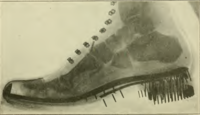
1920 US Marine Corps shoe, with high heel, showing position of pes bones (vertical blackness marks on the 10-ray are nails used to hold the sole and heel on)
-
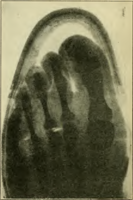
Same shoe from above, showing pointed toe box too narrow for the toes, and hallux valgus deformity. The loftier heel shifts weight frontward, putting additional pressure on the sides of the toes
21st century [edit]
In the Western world, loftier heeled shoes exist in two highly gendered and parallel tracks: highly stylish and variable women's shoes with thin long heels, and practical, relatively uniform men's shoes in a riding boot way, with thick, relatively brusque heels.[xi] Heels are often described every bit a sex symbol for women, and magazines similar Playboy, as well as other media sources that primarily portray women in a sexual way, often practise so using loftier heels. Paul Morris, a psychology researcher at the University of Portsmouth, argues that high heels accentuate "sex-specific aspects of female gait," artificially increasing a woman's femininity.[11] Too, many run across the arching of a woman'due south back facilitated by wearing high heels as an imitation of a bespeak of a woman's willingness to be courted by a human being.[twenty] [21] Despite the sexual connotations, heels are considered both fashionable and professional dress for women in nigh cases, the latter peculiarly if accompanied by a pants adapt. Some researchers debate that high heels have become part of the female person workplace compatible and operate in a much larger and complex set of brandish rules.[xi] High heels are considered to pose a dilemma to women every bit they bring them psychosexual benefits but are detrimental to their wellness.[ original research? ] [22] The 21st century has introduced a wide spectrum and diversity of styles, ranging from height and width of heel, to design and color of the shoe.
Types [edit]
- Stacked heel – usually layers of leather five mm thick stacked together and trimmed to match the shape of the heel.[1] These are unremarkably known equally cake heels.
- Continental heel – 7.5 mm, with the upper part of the chest of the heel spreading towards the center of the shoe.[1]
- Setback heel – similar to the continental heel, but the surface of the back of the heel is direct, forming a right angle.[ane]
- Cuban heel – similar to the continental heel, but not curved, mostly medium top[1]
- Pantaloon heel – "like to pantaloon pants: the top lift part of the heel is spread out every bit it extends to the bottom part of the heel, and the waistline of the heel curves inward naturally."[i]
- Angle heel – "the surface of the base of the heel is directly until reaching the waistline, and information technology looks similar the shape of the Korean letter ¬"[1]
- Pinet heel – straight and skinny[18]
- Cromwell shoe – based on Oliver Cromwell with heel up to 170 mm (6.5 in).[18]
- Bar style – had jewelry or other decorative aspects; associated with flapper civilization.[18]
- New Look in 1947 – a slim, elegant heel, newly created by putting steel in the heel. This enabled the heel to be skinny without snapping.[18]
- Annabelle – seven-cm platform heel[eight]
- Stiletto – alpine, skinny heel; first mentioned in a newspaper in September 1953.[18] The term meaning 'pocketknife', 'blade,' or 'dagger' in Italian.[23]
- Wedges – popularized by Salvatore Ferragamo, who introduced this in the Italian market place in the late 1930s.
- Platform shoe - heel with large platform, or thicker sole, where the ball of the human foot sits. [24]
Materials [edit]

High heels accept been fabricated from a wide multifariousness of materials throughout history. In the early on years, leather and cowhide were preferred. Subsequently, silk and patent leather were introduced. At the aforementioned fourth dimension, cork and woods were utilized equally cheap resources in times of war.[19] Later the World Wars, and the increase in production of steel, the actual heel was often a piece of steel wrapped in some material. This enabled designers to make heels taller and skinnier without them snapping.[25] The soles below the ball of the foot of Ballroom shoes tin can likewise be made of materials similar smooth leather, suede, or plastic.[26]
Health impacts [edit]
Injury and pain [edit]
Wearing high-heeled shoes is strongly associated with injury, including injury requiring hospital care. At that place is evidence that high-heel-wearers fall more frequently, peculiarly with heels higher than ii.5 cm,[vii] fifty-fifty if they were not wearing high heels at the fourth dimension of the fall.[6] Wearing loftier heels is too associated with musculoskeletal pain,[6] specifically pain in the paraspinal muscles (muscles running up the back along the spine)[ citation needed ] and specifically with heel hurting and plantar calluses (only women tested).[vii]
A 2001 survey conducted by Pennsylvania Land Academy using 200 women found that 58% of women complained of lower dorsum pain when wearing heels, and 55% of women said they felt the worst overall back pain when wearing the highest heel.[27] The same written report argues that equally heel height increases, the body is forced to accept on an increasingly unnatural posture to maintain its center of gravity. This changed position places more force per unit area and tension on the lower lumbar spine, which may explain why some of the women complained of astringent dorsum pain at a higher heel length.
In a 1992 report, researchers from the University of California, Davis, and Thomas Jefferson Academy conducted an investigation on the effects of increased heel height on foot pressure using xl-v female participants walking across a force per unit area plate in various heel heights.[28] A Biokinetics software was used to clarify the exact pressure locations on and along each participants' foot. The researchers concluded that an increase in heel height leads to an increase in force per unit area beneath each of the Metatarsal bones of the human foot. Additionally, they institute that the highest heel heights acquired abiding pressure level that could not exist evenly dispersed across the human foot.
In a 2012 report, Kai-Yu Ho, Mark Blanchette, and Christopher Powers investigated the impact of heel height on patellofemoral joint stress during walking.[29] The written report consisted of xi participants wearing tracking and reflective markers equally they walked across a 10-meter force-plated walkway in low, medium, and high heels. The study argued that as the peak of the heel increased, the brawl of the human foot experienced an increment in pressure level resulting in increased discomfort levels and peak patellofemoral joint stress. The researchers as well mentioned that the long-term usage of high heels may atomic number 82 to repetitive overstress of the joint, which may outcome in an increase in hurting and, somewhen, patellofemoral joint osteoarthritis and Patellofemoral pain syndrome.
In a 2012 report, researchers examined the long risk time loftier heel wearers would have in regards to calf Muscle fascicle length and strain.[30] The control grouping consisted of women who wore heels for less than 10 hours weekly and the experimental grouping consisted of women who wore heels for a minimum of twoscore hours weekly for at least two years. The experimental group was told to walk down a walkway barefoot and in heels. In contrast, the command group walked barefoot every bit cameras recorded their movements to calculate muscle fascicle lengths. The data showed that wearing heels shortened the size of the medial gastrocnemius (MG) musculus bundles in the calf significantly equally well equally increasing stiffness in the Achilles Tendon. The experimental grouping likewise demonstrated a more than significant strain on the musculus fascicles while walking in heels because of the flexed position the foot is forced into. The researchers estimated that when wearing heels, the estimated fascicle strains were approximately three times college, and the fascicle strain rate was about six times college. Additionally, they concluded that the long-term usage of high heels could increase the risk of injuries such equally strain and discomfort, and muscle fatigue.
-

Diagram of an Achilles tendon
Bunions [edit]

High-heeled shoes most always have pointed toe boxes[31] which practise not fit around the toes, but readapt them from their natural position.
Wearing high-heeled shoes is associated with developing bunions, a deformity of the foot.[6] [7]
Balance command of the body [edit]
In 2016, scientists from the Department of Physical Therapy in the Sahmyook University in Korea conducted a study to examine increased heel height and gait velocity on balance control.[32] In this study, the participants were told to article of clothing either a low or high heel and walk on a treadmill at a depression and high speed. As a result of this experiment, the researchers argued that as heel superlative increased, the sway velocity of the bodies increased, which also modified the position of the knee articulation, requiring the muscles of the leg to realign the entire body, especially the hips, forth the line of gravity. As the torso'southward weight shifted forrard, the hips were taken out of alignment, and the articulatio genus joints experienced stress to accommodate to the shift.
Postural effects [edit]

In a 2016 study from the Sahmyook University in Korea, researchers investigated the effects of loftier heels on the activation of muscles in the cervical and lumbar portions of the spine.[33] Thirteen women were recruited to walk down a walkway in iii different testing conditions: barefoot, in four cm heels and in 10 cm heels. Surface electrodes were placed on the muscle mass of the women'southward spines and their feet to measure the electric activity of muscles at different points of movement. The study results indicated an increase in both cervical and lumbar musculus activation as heel elevation increased: the cervical spine, the cervix assists in maintaining head stability and postural control in the trunk. The usage of loftier heels shifts the body's center of mass, which requires the spine to arrange itself to maintain residual. The researchers mentioned that these results would increase local musculus fatigue over time, which could lead to musculus swelling, decreased muscle motility, and, in farthermost cases of overuse, tissue deformation.
Vein swelling [edit]
Some research indicates that a possible consequence of wearing high heels is increasing pressure in one's veins. Experiments propose that the higher the heel, the "higher [the] venous pressure in the leg." This means that after repeated use of loftier heels, varicose veins and other undesirable symptoms are much more likely to appear in the legs.[8] Other research supports that claim that wearing high heels can lead to numerous long-term effects, including accidental trauma to multiple areas of the torso.[11]
Legislation [edit]
In Carmel-past-the-Sea, California, heels over two inches high with less than ane square inch of bearing surface can exist worn only with a let.[34]
It has been argued[ by whom? ] that loftier heels in the workplace should be subject field to a health and safety assessment.[35]
In the UK in 2016 temporary receptionist Nicola Thorp was sent home without pay afterward she refused to follow the dress lawmaking of the house Portico. Thorp launched an online petition calling for the UK government to "arrive illegal for a company to require women to wear high heels at piece of work".[36] Two parliamentary committees in January 2017 decided that Portico had broken the law, simply past this fourth dimension the company had already changed its terms of employment.[37] [38] The petition was rejected by the government in April 2017 equally they stated that existing legislation was "adequate".[39] Existing legislation in the UK allows women to exist required to article of clothing high heels, just just if it is considered a job requirement and men in the same chore are required to apparel to an "equivalent level of smartness".[40]
In April 2017 the Canadian province of British Columbia amended workplace legislation to forbid employers from requiring women to wear loftier heels at work.[41] Other Canadian provinces followed suit.[42]
The Philippines forbade companies from mandating that female employees wear high heels at work in September 2017.[43]
The #KuToo campaign in Japan collected over 150,000 signatures on a petition[44] for a ban on mandatory high heels. The government said that they had no plans to change.[45] Japan's labor minister commented that loftier heels are "necessary and appropriate" for women.[46]
Feminism [edit]

High heels can take the effect of sexualizing the wearer.
In the Westward, high heeled shoes are oftentimes regarded every bit an emblem of femininity, and thus have been the subject of analysis past Feminist authors. Some have argued that "high-heeled shoes, possibly more than any other item of clothing, are seen every bit the ultimate symbol of being a woman."[xviii] Mod high heels with thin and long heels ofttimes serve to emphasize the wearer'southward biconvex back and extended buttocks. This "natural courting pose" has sometimes been analyzed as a form of objectification in service of the male gaze.[nine]
Some Feminist scholars have argued that men's views on the culture of high heels are problematic: A sizable proportion of men regard the cultural expectation for women in professional environments to wearable loftier heels equally unproblematic.[47] All the same, it has not been popular for men to clothing tall and thin high heels since the belatedly 17th century.[x] Thus, since some women report that high heels are often painful to walk in,[ane] and commonly event in negative side effects to joints and veins after prolonged use,[8] many take argued that information technology is unreasonable of men to back up such a cultural norm.
At the feminist Miss America protest in 1968, protestors symbolically threw a number of feminine products into a "freedom trash tin." These included loftier heels,[48] which were amongst items the protestors chosen "instruments of female torture"[49] and accouterments of what they perceived to be enforced femininity.
In 2015, a group of women were turned away from a moving-picture show premiere at the Cannes Film Festival in French republic for wearing flat shoes, including a adult female physically unable to vesture heels due to an performance on one of her feet.[50] The women complained that the policy of the festival on women's footwear was unjust. Festival organizers afterwards responded that there was no official policy on footwear and stated that they would remind red-carpet officials of this.[15] [51]
Dress codes [edit]
Some dress codes require women to article of clothing high heels, and some medical organizations accept chosen for a ban on such apparel codes.[six] There accept been many protests by women workers confronting such policies. Laws regarding dress codes that require women to wear loftier heels in the workplace vary.
A Mile in Her Shoes [edit]

A Mile in Her Shoes: men walk a mile in loftier heels to support domestic violence victims
A Mile in Her Shoes is an almanac march in which men article of clothing red high heels and walk a mile to protest domestic violence. Some academics[ who? ] have suggested that by wearing high heels for such a brief period and making a betoken of acting similar they do not know how to walk properly, these men reinforce the stereotype that only women tin or should clothing high heels.[52]
Children [edit]

High heels are marketed to children, and some schools encourage children to habiliment them.[half-dozen] 18% of injuries from wearing high heels were in children, and 4% in nether-tens, in a 2002–2012 U.s. survey.[6] A 2016 medical review on high-heeled shoes expressed business concern about children'southward utilize of high heels.[6] A ix-year-old is about half an adult's height, and a toddler about a quarter; then, relative to torso superlative, a 2-inch (v cm) heel on an adult would exist a one-inch heel on the nine-year-quondam, and a half-inch heel on the toddler,[31] though whether this translates to comparable health harms is non known.[6]
Dancing [edit]
Styles of dance that employ heels [edit]
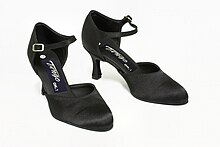
Standard ballroom tango shoes
Many styles of dance are performed in heels. Ballroom dancing shoes are specific to the trip the light fantastic manner being performed. International Standard ballroom shoes for women are closed-toed shoes with a sturdy 2-to-2.5-inch heel considering steps are performed using the human foot'southward heel.[53] International Latin and American Rhythm shoes are open-toed, strapped heels that are an average of ii.5 to iii inches in height. These shoes have the least sturdy heel considering International Latin and American Rhythm styles are performed on the ball of the human foot. This mode of shoe is designed with a flexible sole to allow pointed feet. Lastly, American Smooth shoes are airtight-toed, flexible-soled shoes that range in heel height from 2 to 2.five inches.
A non-traditional ballroom dance that uses heels is the Argentine tango. While dancing the Argentine tango, women often habiliment pointed heels ranging in height from 2 to 4 inches.[26] More advanced dancers typically choose higher heels. The heels can take a significant impact on the posture of a dancer past tilting the pelvis and making the buttocks more than prominent, forcing the abdomen in and pushing the breasts out.[54] They can besides crusade instability every bit they force women to trip the light fantastic toe on their toes and lean on their partner, which adds to the fluidity of the movements.
A modernistic style of trip the light fantastic chosen heels choreography or stiletto trip the light fantastic specializes in choreography that blends the styles of jazz, hip-hop and burlesque with the fusion of vogue movements and is performed using stilettos or loftier heels.[55] Dancers such as Yanis Marshall specialize in dancing with high heels.[56]
Injuries [edit]
Some dance-related injuries are attributable to the use of heels. In item, shoes with a narrow space for the toes can clasp tightly enough to cause human foot deformity.[57] Dancers can add cushioning to the soles of their dancing shoes or inserts to ease the pain during dancing.[26]
See as well [edit]
- Desert boots
- Fashion boots
- Foot binding
- Pointed shoe (disambiguation)
- Riding boots
- Thigh-high boots
- Ballet kicking
- Cowboy kick
- Elevator shoes
- Fuck-me shoes
- Loftier heel policy
- Insolia
- Locomotor effects of shoes
- Platform boots
- Removable heel
- Stiletto heel
- Wedge heel
References [edit]
- ^ a b c d e f thousand h Han, Dongwook (2015). "Musculus activation of paraspinal muscles in different types of high heels during continuing". Journal of Physical Therapy Scientific discipline. 27 (1): 67–69. doi:10.1589/jpts.27.67. PMC4305600. PMID 25642040.
- ^ a b c Andrew Reilly; Ben Barry (24 February 2020). Crossing Gender Boundaries: Way to Create, Disrupt and Transcend. Intellect Books. pp. 98–. ISBN978-1-78938-115-iii.
- ^ a b c d eastward f "Standing TALL: The Curious History of Men in Heels". Google Arts and Culture. Bata Shoe Museum, Toronto, Canada. 2017. Retrieved twenty Baronial 2021.
{{cite web}}: CS1 maint: url-status (link) - ^ "BBC Radio 4 - Radio 4 in Four - Nine testify-stopping facts about high heels". BBC . Retrieved 4 August 2021.
- ^ Ravindra S. Goonetilleke (6 November 2012). The Science of Footwear. CRC Press. pp. 542–. ISBN978-1-4398-3569-2.
- ^ a b c d e f yard h i j Barnish, MS; Barnish, J (thirteen January 2016). "High-heeled shoes and musculoskeletal injuries: a narrative systematic review". BMJ Open. 6 (one): e010053. doi:10.1136/bmjopen-2015-010053. PMC4735171. PMID 26769789.
- ^ a b c d Jellema, AH; Huysmans, T; Hartholt, K; van der Cammen, TJM (September 2019). "Shoe design for older adults: Testify from a systematic review on the elements of optimal footwear". Maturitas. 127: 64–81. doi:10.1016/j.maturitas.2019.06.002. PMID 31351522.
- ^ a b c d Tedeschi Filho, Wagner; Dezzotti, Nei R.A.; Joviliano, Edvaldo E.; Moriya, Takachi; Piccinato, Carlos Eli (October 2012). "Influence of high-heeled shoes on venous function in immature women". Journal of Vascular Surgery. 56 (iv): 1039–1044. doi:x.1016/j.jvs.2012.01.039. PMID 22483354.
- ^ a b c Kremer, William (25 January 2013). "Why did men stop wearing high heels?". bbc.com. BBC. Retrieved twenty June 2018.
- ^ a b c d Avery Trufelman. "Feet of Applied science". 99% Invisible. Jun 2014.
- ^ a b c d e Morris, Paul; Jenny White; Edward Morrison; Kayleigh Fisher (May 2013). "High Heels are Supernormal Stimuli: How Wearing Loftier Heels Affects Judgments of Female Attractiveness". Development and Human Behavior. 34 (3): 176–181. doi:10.1016/j.evolhumbehav.2012.xi.006.
- ^ Margo DeMello (2009). "Sumptuary laws". Feet and Footwear: A Cultural Encyclopedia. Greenwood Printing/ABC-CLIO. p. 311. ISBN978-0-313-35714-5.
- ^ Margo DeMello (10 September 2009). "U.s.". Anxiety and Footwear: A Cultural Encyclopedia. ABC-CLIO. p. 323. ISBN978-0-313-35715-2.
- ^ Wade, Lisa. "From Manly to Sexy: The History of the Loftier Heel" The Order Pages. 5 February 2013.
- ^ a b c d Klaus, Carl (2011). Shoes. Parkstone International. p. 72. ISBN9781780421971 . Retrieved half dozen May 2021.
- ^ a b Blanco F José, et al., editors. Wearable and Fashion: American Fashion from Caput to Toe. Santa Barbara, California, ABC-CLIO, an Imprint of ABC-CLIO, LLC, 2016. Impress.
- ^ John Brookes (1859), Manners, and Customs of the English Nation, James Blackwood, pp. 261–262,
In the year 1770 an deed was introduced into Parliament against hoops, false hair, high heels...
- ^ a b c d e f thousand Shawcross, Rebecca. "High Heels." The Berg Companion to Mode. Ed. Valarie Steele. Oxford: Bloomsbury Academic, 2010. Web.
- ^ a b c Stabb, Jo Ann. "The Early on 20th Century Through World State of war Two" Vesture and Fashion: American Fashion from Head to Toe, edited by Jose Blanco, vol. 3 ABC-CLIO, pp. 330-332. Gale Virtual Reference Library.
- ^ Elizabeth Hawkins (25 October 2017). "Why arched backs are attractive". springer.com.
- ^ Pazhoohi, F.; Doyle, J.F.; Macedo, A.F.; Arantes, J. (2017). "Arching the Back (Lumbar Curvature) equally a Female Sexual Proceptivity Indicate: an Eye-Tracking Study". Evolutionary Psychological Science. four (ii): 1–eight. doi:ten.1007/s40806-017-0123-seven. S2CID 149046079.
- ^ Barnish Thousand, Morgan HM, Barnish J (2018). "The 2016 Loftier Heels: Health effects And psychosexual BenefITS (Loftier HABITS) study: systematic review of reviews and boosted primary studies". BMC Public Health (Review). 18 (1): 37. doi:10.1186/s12889-017-4573-4. PMC5537921. PMID 28760147.
- ^ "Italian Translation of "stiletto" | Collins English-Italian Lexicon". www.collinsdictionary.com . Retrieved 4 August 2021.
- ^ http://blogs.britannica.com/2011/07/attitude-altitude-short-history-shoes/
- ^ Schwartz, Jessica. "Stiletto Heels." Habiliment and Manner: American Style from Head to Toe, edited by Jose Blanco, vol. 4: The Postwar Period into the 21st century, ABC-CLIO, pp. 281-282. Gale Virtual Reference Library.
- ^ a b c Littig, Beate (2013). "On high heels: A radiography of doing Argentine tango". European Journal of Women's Studies. twenty (4): 455–467. doi:x.1177/1350506813496397. ISSN 1350-5068. S2CID 144253838.
- ^ Lee, Chang-Min; Jeong, Eun-Hee; Freivalds, Andris (2001). "Biomechanical effects of wearing high-heeled shoes". International Journal of Industrial Ergonomics. 28 (6): 321–326. doi:10.1016/s0169-8141(01)00038-5. ISSN 0169-8141.
- ^ Snow, Rebecca Eastward.; Williams, Keith R.; Holmes, George B. (1992). "The Furnishings of Wearing Loftier Heeled Shoes on Pedal Pressure in Women". Pes & Ankle. xiii (ii): 85–92. doi:x.1177/107110079201300206. ISSN 0198-0211. PMID 1572591. S2CID 2694160.
- ^ Ho, Kai-Yu; Blanchette, Mark G.; Powers, Christopher M. (2012). "The influence of heel top on patellofemoral joint kinetics during walking". Gait & Posture. 36 (2): 271–275. doi:10.1016/j.gaitpost.2012.03.008. ISSN 0966-6362. PMID 22520457.
- ^ Cronin, Neil J.; Barrett, Rod S.; Carty, Christopher P. (fifteen March 2012). "Long-term employ of high-heeled shoes alters the neuromechanics of man walking". Periodical of Applied Physiology. 112 (six): 1054–1058. doi:10.1152/japplphysiol.01402.2011. ISSN 8750-7587. PMID 22241055. S2CID 6257203.
- ^ a b Rossi, William A. (Feb 2001). "Footwear: The Main Cause of Foot Disorders" (PDF).
- ^ Jang, Il-Yong; Kang, Da-Haeng; Jeon, Jae-Keun; Jun, Hyun-Ju; Lee, Joon-Hee (2016). "The furnishings of shoe heel height and gait velocity on position sense of the human knee joint and balance". Journal of Physical Therapy Scientific discipline. 28 (9): 2482–2485. doi:10.1589/jpts.28.2482. ISSN 0915-5287. PMC5080157. PMID 27799675.
- ^ Park, Kisu; Kim, Immature; Chung, Yijung; Hwang, Sujin (2016). "Effects of the top of shoe heels on muscle activation of cervical and lumbar spine in healthy women". Journal of Physical Therapy Scientific discipline. 28 (3): 956–959. doi:ten.1589/jpts.28.956. ISSN 0915-5287. PMC4842473. PMID 27134392.
- ^ Bell, Diane (11 September 2014). "Carmel loftier heel ban makes Ripley'due south". San Diego Union-Tribune.
- ^ "High heels 'should be banned at work'". Archived from the original on 23 September 2009. Retrieved 14 Nov 2019.
- ^ Johnston, Chris (12 May 2016). "Woman's high-heel petition receives 100,000-plus signatures". the Guardian . Retrieved xiii May 2016.
- ^ McIntosh, Lindsay (xvi May 2016). "Heel-loving Sturgeon steps into shoe debate". The Times. London. Retrieved seven March 2017. (subscription required)
- ^ Bilefsky, Dan (6 March 2017). "British Adult female's Revolt Against High Heels Becomes a Crusade in Parliament". The New York Times . Retrieved 7 March 2017.
- ^ "High heels row: Petition for work wearing apparel code police force rejected". BBC News. 21 April 2017. Retrieved 21 April 2017.
- ^ Yorke, Harr (21 April 2017). "Employers tin can force women to habiliment high heels equally Government rejects campaign to ban the exercise". The Telegraph. Archived from the original on 12 Jan 2022.
- ^ Collig, Pádraig (eight April 2017). "Canadian province makes information technology illegal to crave women to article of clothing loftier heels". The Guardian . Retrieved 8 April 2017.
- ^ "Alberta takes steps to ban mandatory loftier heels in the workplace | National Post". National Mail service. xxx November 2018. Retrieved eleven Nov 2019.
- ^ Yi, Beh Lih (25 September 2017). "Philippines bans mandatory loftier heels at work". Reuters. Retrieved 29 July 2019.
- ^ "#KuToo no more than! Japanese women take stand confronting high heels". Reuters. vi June 2019. Retrieved 29 October 2019.
- ^ Hollingsworth, Julia (four June 2019). "Japanese women revolt against loftier heel requirements". CNN Style.
- ^ Loftier heels at work are necessary, says Japan's labour government minister The Guardian, 2019
- ^ Reynaud, Bérénice (Jan 2002). "These Shoes are Made for Walking". Afterall: A Journal of Fine art, Context and Enquiry. 6: 42–51. doi:10.1086/aft.6.20711475. S2CID 184089741.
- ^ Dow, Bonnie J. (Spring 2003). "Feminism, Miss America, and Media Mythology". Rhetoric & Public Diplomacy. 6 (1): 127–149. doi:x.1353/rap.2003.0028. S2CID 143094250.
- ^ Duffett, Judith (October 1968). WLM vs. Miss America. Vocalization of the Women's Liberation Movement. p. 4.
- ^ "Emily Blunt on Cannes heels row: 'everybody should clothing flats'". The Telegraph. 19 May 2015. Archived from the original on 12 January 2022. Retrieved 16 May 2016.
- ^ "Cannes denies high-heel rule for women on red carpet". www.yahoo.com . Retrieved 16 May 2016.
- ^ Bridges, Tristan Southward. (2010). "Men But Weren't Made to do This". Gender & Society. 24: five–30. doi:x.1177/0891243209356924. S2CID 145672875.
- ^ "Ballroom Guide - Shoe Guide Page 1 What are Dance Shoes?". www.ballroomguide.com. Retrieved nineteen March 2019.
- ^ Linder and Saltzman (1998), "A HISTORY OF MEDICAL SCIENTISTS ON HIGH HEELS" International Periodical of Health Services. 28(2): 201-225 https://www.jstor.org/stable/pdf/45130648.pdf?ab_segments=0%252FSYC-5770%252Fcontrol&refreqid=excelsior%3A465fe3bcf2374793363dd8cb4c625c80
- ^ "Dance Middle Myway - Стили / Heels". mywaydance.com . Retrieved one March 2019.
- ^ YANIS MARSHALL (28 December 2015). "Yanis Marshall - The Choreographer - Zumanity: Rated Cirque - Ep. 1- Cirque Du Soleil". Archived from the original on 18 November 2021 – via YouTube.
- ^ Han, Dongwook (2015). "Musculus activation of paraspinal muscles in different types of loftier heels during standing". Periodical of Physical Therapy Scientific discipline. 27 (i): 67–69. doi:10.1589/jpts.27.67. ISSN 0915-5287. PMC4305600. PMID 25642040.
External links [edit]
- Bata Shoe Museum
- High Heel Shoe museum
- "How to Wear Loftier Heels"—Cosmopolitan
0 Response to "When Did High Heels Come Into Fashion"
Post a Comment