Old Fashioned Country Retreats in England

An English language state house is a big house or mansion in the English countryside. Such houses were ofttimes owned past individuals who besides endemic a town house. This allowed them to spend time in the country and in the city—hence, for these people, the term distinguished between town and land. Still, the term likewise encompasses houses that were, and often still are, the full-fourth dimension residence for the landed gentry that ruled rural Britain until the Reform Act 1832.[ane] Frequently, the formal business of the counties was transacted in these land houses, having functional antecedents in estate houses.
With large numbers of indoor and outdoor staff, state houses were important as places of employment for many rural communities. In turn, until the agricultural depressions of the 1870s, the estates, of which land houses were the hub, provided their owners with incomes. Nevertheless, the belatedly 19th and early 20th centuries were the swansong of the traditional English state house lifestyle. Increased taxation and the furnishings of World War I led to the demolition of hundreds of houses; those that remained had to adapt to survive.
While a château or a Schloss tin can be a fortified or unfortified building, a country business firm, similar to an Ansitz, is commonly unfortified. If fortified, it is called a castle, simply not all buildings with the name "castle" are fortified (for example Highclere Castle).
Stately homes of England [edit]

Longleat House was the showtime country house to open up to the public, and as well claims the outset safari park outside Africa.[2] [three] It became the start property in what later on was known as the stately home industry.[ commendation needed ]
The term stately home is subject to debate, and avoided by historians and other academics. Every bit a description of a land house, the term was beginning used in a verse form by Felicia Hemans, "The Homes of England", originally published in Blackwood's Mag in 1827. In the 20th century, the term was after popularised in a song by Noël Coward,[4] and in modern usage it often implies a land house that is open to visitors at least some of the time.[ commendation needed ]
In England, the terms "land business firm" and "stately home" are sometimes used vaguely and interchangeably; yet, many state houses such every bit Ascott in Buckinghamshire were deliberately designed not to be stately, and to harmonise with the landscape, while some of the keen houses such every bit Kedleston Hall and Holkham Hall were congenital as "ability houses" to dominate the landscape, and were most certainly intended to be "stately" and impressive.[5] In his volume Historic Houses: Conversations in Stately Homes, the author and journalist Robert Harling documents nineteen "stately homes"; these range in size from the vast Blenheim Palace to the minuscule Ebberston Hall, and in compages from the Jacobean Renaissance of Hatfield House to the eccentricities of Sezincote. The book'southward collection of stately homes besides includes George 4'south Brighton town palace, the Royal Pavilion.[vi]

Development [edit]

Forde Abbey in Dorset. Many country houses have evolved and been extended over several centuries. Here, the architecture runs from Medieval ecclesiastical to Palladian and on to Strawberry Colina Gothic, while at sometime an attempt at unity has been made by the employ of crenelation.
The country houses of England have evolved over the last five hundred years. Earlier this time, larger houses were normally fortified, reflecting the position of their owners as feudal lords, de facto overlords of their manors. The Tudor period of stability in the country saw the building of the beginning of the unfortified great houses. Henry VIII's Dissolution of the Monasteries saw many former ecclesiastical properties granted to the King's favourites, who then converted them into individual country houses. Woburn Abbey, Forde Abbey and many other mansions with abbey or priory in their proper name became private houses during this catamenia. Other terms used in the names of houses to describe their origin or importance include palace, castle, court, hall, mansion, park, house, estate, and place.
Information technology was during the 2nd half of the reign of Elizabeth I, and nether her successor, James I, that the first architect-designed mansions, thought of today every bit epitomising the English state house, began to make their appearance. Burghley Firm, Longleat Firm, and Hatfield Business firm are among the best-known examples of the showy prodigy business firm, often congenital with the intention of alluring the monarch to visit. By the reign of Charles I, Inigo Jones and his form of Palladianism had changed the confront of English language domestic architecture completely, with the use of turrets and towers as an architectural reference to the earlier castles and fortified houses completely disappearing. The Palladian mode, in various forms, interrupted briefly by baroque, was to predominate until the 2nd half of the 18th century when, influenced by ancient Greek styles, it gradually evolved into the neoclassicism championed past such architects as Robert Adam.
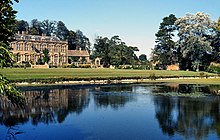
Brympton d'Evercy in Somerset evolved from the Medieval period; its provincial architects are long forgotten. Yet, Christopher Hussey described it as "The virtually incomparable house in Britain, the 1 which created the greatest impression and summarises and so exquisitely English country life qualities".[vii]
Some of the best known of England's country houses were built by i architect at one particular time: Montacute Business firm, Chatsworth Firm, and Blenheim Palace are examples. While the latter two are ducal palaces, Montacute, although built by a Master of the Rolls to Queen Elizabeth I, was occupied for the next 400 years past his descendants, who were gentry without a London townhouse, rather than aristocracy. They finally ran out of funds in the early 20th century.
Withal, the vast majority of the lesser-known English state houses, often endemic at dissimilar times by gentlemen and peers, are an evolution of one or more styles with facades and wings in different styles in a mixture of loftier architecture, oftentimes as interpreted by a local architect or surveyor, and determined by practicality equally much as by the whims of architectural sense of taste. An case of this is Brympton d'Evercy in Somerset, a house of many periods that is unified architecturally past the standing utilize of the aforementioned mellow, local Ham Hill stone.
The fashionable William Kent redesigned Rousham House just to have information technology rapidly and drastically altered to provide space for the owner'due south twelve children. Canons Ashby, habitation to poet John Dryden's family, is another example of architectural evolution: a medieval farmhouse enlarged in the Tudor era around a courtyard, given grandiose plaster ceilings in the Stuart period, so having Georgian façades added in the 18th century. The whole is a glorious mismatch of styles and fashions that seamlessly blend together. These could be called the truthful English state house. Wilton House, one of England's grandest houses, is in a remarkably similar vein; although, while the Drydens, mere squires, at Canons Ashby employed a local architect, at Wilton the mighty Earls of Pembroke employed the finest architects of the day: first Holbein, 150 years later Inigo Jones, and then Wyatt followed past Chambers. Each employed a different style of architecture, seemingly unaware of the pattern of the fly around the next corner. These varying "improvements", often criticised at the time, today are the qualities that make English country houses unique.
Sizes and types [edit]
Wealthy and influential people, often bored with their formal duties, go to the country in order to leave of London, the ugliest and most uncomfortable metropolis in the world; they invented the long week-end to stay away as long every bit possible. Their métier is politics; they talk politics; and they brand politics, quite spontaneously.
In that location are no written terms for distinguishing between vast country palaces and comparatively small country houses; the descriptive terms, which tin can include castle, estate and courtroom, provide no firm clue and are often only used because of a historical connection with the site of such a edifice.[9] Therefore, for ease or explanation, Uk'south country houses can be categorised according to the circumstances of their creation.
Ability houses [edit]
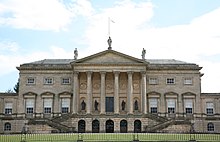
The peachy houses are the largest of the country houses; in truth palaces, congenital by the state'southward most powerful – these were designed to brandish their owners' power or ambitions to power.[10] Really large unfortified or barely fortified houses began to take over from the traditional castles of the crown and magnates during the Tudor menstruum, with vast houses such as Hampton Court Palace and Burghley House, and continued until the 18th century with houses such as Castle Howard, Kedleston Hall and Holkham Hall.[11] Such edifice reached its zenith from the belatedly 17th century until the mid-18th century; these houses were often completely built or rebuilt in their entirety by i eminent builder in the most fashionable architectural fashion of the day and often have a suite of Baroque land apartments, typically in enfilade, reserved for the most eminent guests, the entertainment of whom was of paramount importance in establishing and maintaining the ability of the owner. The common denominator of this category of English country houses is that they were designed to be lived in with a certain degree of anniversary and pomp. Information technology was not unusual for the family to accept a small suite of rooms for withdrawing in privacy away from the multitude that lived in the household. These houses were e'er an alternative residence to a London business firm.
During the 18th and 19th centuries, for the highest echelons of English guild, the country house served as a place for relaxing, hunting and running the country with one's equals at the end of the week, with some houses having their ain theatre where performances were staged.
The country house, notwithstanding, was not but an oasis of pleasure for a fortunate few; information technology was the centre of its ain world, providing employment to hundreds of people in the vicinity of its estate. In previous eras, when state benefits were unheard of, those working on an estate were among the most fortunate, receiving secured employment and rent-free accommodation. At the summit of this category of people was the indoor staff of the state business firm. Unlike many of their contemporaries prior to the 20th century, they slept in proper beds, wore well-made adequate clothes and received iii proper meals a twenty-four hours, plus a small wage. In an era when many still died from malnutrition or lack of medicine, the long working hours were a small price to pay.[ citation needed ]
Every bit a result of the aristocratic habit of simply marrying inside the elite, and whenever possible to a sole heiress, many owners of state houses endemic several state mansions,[12] and would visit each according to the season: Grouse shooting in Scotland, pheasant shooting and fox hunting in England. The Earl of Rosebery, for instance, had Dalmeny House in Scotland, Mentmore Towers in Buckinghamshire, and another house near Epsom only for the racing flavor.[13] For many, this way of life, which began a steady decline in 1914, continued well into the 20th century, and for a very few continues to this twenty-four hours.
Small-scale country houses [edit]
In the 2d category of Britain's country houses are those that belonged to the squirearchy or landed gentry. These tend either to have evolved from medieval hall houses, with rooms added as required, or were purpose-built by relatively unknown local architects. Smaller, and far greater in number than the "power houses", these were still the epicentre of their own estate, but were often the only residence of their owner.
However, whether the owner of a "power house" or a small manor, the inhabitants of the English land firm accept become collectively referred to as the ruling course, because this is exactly what they did in varying degrees, whether by having high political influence and power in national government, or in the solar day-to-solar day running of their own localities or "canton" in such offices as lord/deputy lieutenant, magistrates, or occasionally even clergy.[14]
The State house mystery was a pop genre of English detective fiction in the 1920s and 1930s; fix in the residence of the gentry and often involving a murder in a country firm temporarily isolated by a snowstorm or similar with the suspects all at a weekend house party.
Victorian houses [edit]
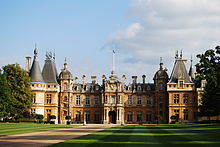
Waddesdon Manor, Buckinghamshire. During the Victorian era, vast country houses were congenital in a multifariousness of styles past wealthy industrialists and bankers.
Following the Industrial Revolution of the 18th century, a third category of country houses was congenital equally newly rich industrialists and bankers were eager to display their wealth and taste. By the 1850s, with the English language economy booming, new mansions were built in 1 of the many revivalist architectural styles popular throughout the 19th century.[15] The builders of these new houses were able to take reward of the political unrest in Europe that gave rise to a big merchandise in architectural salvage.[fifteen] This new wave of country house building is exemplified by the Rothschild properties in the Home counties and Bletchley Park (rebuilt in several styles, and famous for its code-breaking role in World War II).
Decline [edit]

Trentham, Staffordshire. During the 20th century, thousands of state houses were demolished, their rock and fixtures sold. During this era, many fine architectural features were transported to the US.
The slow refuse of the English language country house coincided with the rise non simply of tax, but too of modernistic industry, along with the agricultural low of the 1870s. By 1880, this had led some owners into financial shortfalls as they tried to residue maintenance of their estates with the income they provided. Some relied on funds from secondary sources such as banking and merchandise while others, like the severely impoverished Duke of Marlborough, sought to ally American heiresses to salvage their country houses and lifestyles.[16]
The ultimate demise began immediately following World State of war I. The members of the huge staff required to maintain large houses had either left to fight and never returned, departed to piece of work in the munitions factories, or filled the void left past the fighting men in other workplaces. Of those who returned after the war, many left the countryside for better-paid jobs in towns. The final blow for many country houses came following World War II; having been requisitioned during the state of war, they were returned to the owners in poor repair. Many manor owners, having lost their heirs, if not in the immediately preceding war so in World War I, were now paying far higher rates of tax, and agricultural incomes had dropped. Thus, the solution for many was to hold contents auctions and and then demolish the house and sell its rock, fireplaces, and panelling. This is what happened to many of U.k.'southward finest houses.
Despite this slow decline, and then necessary was the country business firm for entertaining and prestige that in 1917 Viscount Lee of Fareham donated his country business firm Chequers to the nation for the utilise of a prime minister who might not possess one of his own. Chequers all the same fulfills that need today as practise both Chevening Business firm and Dorneywood, donated for sole use of loftier-ranking ministers of the Crown.
Today [edit]
Today, many country houses accept become hotels,[17] schools, hospitals, museums and prisons, while others have survived as conserved ruins, but from the early 20th century until the early 1970s, hundreds of country houses were demolished. Houses that survived destruction are now mostly Grade I or Two listed as buildings of historic interest—and only the most faithful, nigh accurate, and most precise restoration and re-creation are permitted. Such piece of work, nonetheless, is commonly very expensive, although the system does ensure that everything is done correctly and authentically. The negative side is that many owners cannot afford the work, so a roof remains leaking for the sake of a inexpensive roof tile.
Although the ownership or management of some houses has been transferred to a private trust, most notably at Chatsworth, other houses accept transferred fine art works and furnishings under the Acceptance in Lieu scheme to buying by various national or local museums, but are retained for brandish in the building. This enables the former owners to offset taxation, the payment of which would otherwise have necessitated the auction of the fine art works. For instance, tapestries and furniture at Houghton Hall are now owned by the Victoria and Albert Museum. In addition, increasing numbers of land houses concord licences for weddings and civil ceremonies. Another source of income is to apply the business firm as a venue for parties,[18] a film location and a corporate entertainment venue. While many country houses are open to the public, they remain inhabited private houses, in some cases by the descendants of their original owners.
The lifestyles of those living and working in a country house in the early 20th century were recreated in a BBC boob tube programme, The Edwardian Country House, which was filmed at Manderston Firm in Scotland. Another particularly popular tv set program that features the dynamics of life in country houses is Downton Abbey, which aired on ITV in the United Kingdom and PBS in the United States.[19]
Meet too [edit]
- English country houses with changed utilize
- Estate houses in Scotland
- List of country houses in the United Kingdom
- List of National Trust properties in England
- List of English Heritage properties
- Listing of castles in England
- List of celebrated buildings of the Great britain – country house architectural periods and styles
- Celebrated firm
- The Edwardian Country House, a Channel four series
- Downton Abbey
- Manor house
- Prodigy firm
- Roman villa
- British land house contents auctions
- State house theatre
- Country house poem
- Treasure Houses of England
- State Life
References [edit]
- ^ Every bit documented in The Purefoy Letters, 1735–53 by 50. K Mitchell.
- ^ The lions and loins of Longleat Archived 29 June 2011 at the Wayback Machine The Sunday Times Retrieved 18 February 2011
- ^ New Scientist 2 Dec 1982 Archived 21 May 2016 at the Wayback Machine Retrieved xviii Feb 2011
- ^ "The Stately Homes of England" by Noël Coward (1938) was featured in his musical "Operette", which premiered in the same year.
- ^ Girouard, p.
- ^ Harling, p ane–16.
- ^ Country Life, Saturday, 7 May 1927.
- ^ Gunther, John (1940). Within Europe. New York: Harper & Brothers. p. 287.
- ^ The term palace is very seldom used in England at all, especially for a land house, and when information technology is used, it can be for a adequately small house such as Eltham Palace with former royal connections or a monumentally huge house such every bit Blenheim Palace.[ commendation needed ]
- ^ Girouard, p2-12.
- ^ Girouard, p. 2-12.
- ^ Worsley, p. x.
- ^ McKinstrey, p181.
- ^ Girouard, p2, describes a squire as "similar a little king in his village.
- ^ a b Hall, p25.
- ^ Stuart, p. 135.
- ^ "Staying at an English Manor House". AGLAIA Mag. half-dozen November 2018. Archived from the original on 19 Jan 2019. Retrieved 19 Jan 2019.
- ^ "Large Houses to Rent for Parties". Mansions & Big Houses for Rent for Parties & Weddings United kingdom of great britain and northern ireland. nine June 2012. Archived from the original on 8 February 2021. Retrieved 22 March 2017.
- ^ "Downton Abbey on MASTERPIECE on PBS". PBS. Archived from the original on 26 October 2019. Retrieved 29 Oct 2019.
- Sources
- Arrogance, Malcolm (1975). The Making of the English Country House, 1500–1640. London: Architectural Printing. ISBN0-85139-378-0.
- Girouard, Mark (1978). Life in the English Country House: A Social and Architectural History . New Haven: Yale University Printing. ISBN0-300-02273-v. Details the touch on of social change on design.
- Hall, Michael (2009). The Victorian Country House. London: Aurum Press Ltd. ISBN978-one-84513-457-0.
- Kroll, Alexander, ed. (1969). Historic Houses: Conversations in Stately Homes. Discussions with Robert Harling. London: Condé Nast. ISBN0-900303-05-0.
- Lewis, Lesley (1997). The Private Life of a Country House. Stroud: Sutton. ISBN0-7509-1678-viii. Gives much detail of how a smaller country firm operated in the early 20th century.
- Lycett Green, Candida (1991). The Perfect English Country Business firm. London: Pavilion Books ltd. ISBN1-85145-551-5.
- McKinstry, Leo (2005). Rosebery: A Statesman in Turmoil. London: John Murray. ISBN0-7195-6586-3.
- Murdoch, Tessa (2006). Noble Households: Eighteenth-Century Inventories of Nifty English Houses. A Tribute to John Cornforth. Cambridge: John Adamson. ISBN978-0-9524322-5-viii.
- Stuart, Amanda Mackenzie (2005). Consuelo and Alva Vanderbilt: The Story of a Daughter and Mother in the Gilded Age . New York: Harper Perennial. ISBN978-0-06-093825-3.
- Worsley, Giles (2002). England's Lost Houses. London: Aurum Press. ISBNone-85410-820-4.
External links [edit]
- The National Trust – England, Wales, & Northern Ireland
- The National Trust for Scotland
- English Heritage
- Historic Houses Association
- Hudson's Historic Houses and Gardens – Hudson's list of 2,000 backdrop open up to the public
- The DiCamillo Companion to British & Irish Country Houses
- Lost Heritage – A Memorial to the Lost Country Houses of England
0 Response to "Old Fashioned Country Retreats in England"
Post a Comment